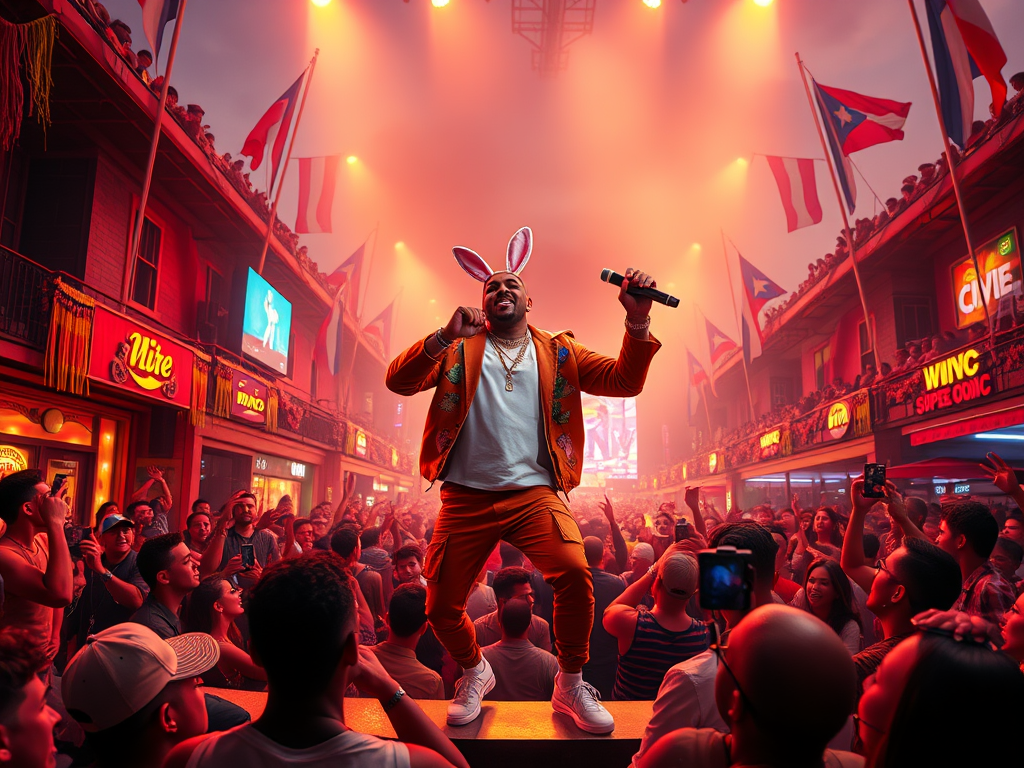
When Bad Bunny was announced as the 2026 halftime performer, the backlash began before he ever touched the stage. Social media flooded with complaints: Why Spanish? Why him? Why here? As if the Super Bowl were some fragile museum piece instead of a living cultural event.
The irony? The United States has no official federal language. English dominates in practice, yes—but legally, America has always defined itself as multilingual and multicultural. Yet suddenly, hearing Spanish at an “all-American” event felt threatening to some. That discomfort said far more about the audience than the artist.
And let’s be clear: Puerto Rico isn’t “foreign.” It is a U.S. territory. Puerto Ricans are U.S. citizens. They serve in the military. They pay federal taxes in many forms. Yet they can’t vote for president and have only a non-voting representative in Congress. Their political status remains unresolved—a quiet injustice hiding in plain sight.
So when critics complained about a “Latino” presence on the biggest American stage, what they were really revealing was selective patriotism.
Puerto Rico: American, But Not Equal
Puerto Rico’s story is layered. Indigenous roots. Four centuries of Spanish rule. U.S. control since 1898. Citizenship since 1917—without full political power.
It is a place shaped by resilience, migration, industry, tourism, and survival. It has been economically useful to the U.S. and politically convenient to overlook.
In many ways, the island reflects a core contradiction of American identity: ownership over partnership. Control over care. Capital over community.
Bad Bunny didn’t bring this history to the stage with speeches. He brought it with symbolism.
The Halftime Show as a Cultural Map
This wasn’t just a performance. It was a visual essay.
The Child and the Grammy
When Bad Bunny handed his Grammy to a young boy, it felt like a conversation with his younger self. A quiet message: We made it. We survived. We’re here.
It was about dreams carried across generations.
The Shops
The small storefronts embedded in the show reflected real Puerto Rican neighborhoods—local economies, family businesses, and informal networks that hold communities together when institutions fail. Many of these weren’t fictional sets, but recreations of real places with real addresses and real histories. If you take five minutes to Google their names and locations, you’ll uncover stories of migration, survival, and community resilience that no halftime broadcast could fully explain.

The Bushes and Fields
Performers dressed as foliage and workers evoked agricultural labor, tobacco fields, and environmental realities. A reminder that much of prosperity is built on invisible hands.
The Power Lines
Perhaps the most haunting image. In Puerto Rico, many people risk their lives daily climbing unstable electrical infrastructure after repeated grid failures. These aren’t metaphors. They’re lived realities.
Naming the Americas
By referencing countries across North, Central, and South America, Bad Bunny rejected borders as barriers. He framed the hemisphere as interconnected—a shared story, not isolated silos.
The White Jersey
Wearing white—symbolizing purity and honesty—he displayed his mother’s last name. In many Latin cultures, matriarchy is foundational. Women hold families together. They transmit memory. They stabilize chaos.
This quietly contradicted the hyper-patriarchal politics dominating much of American public life.
No shouting. No slogans. Just symbolism.
That’s power.

So Why the Backlash?
Because unity threatens systems built on division.
Many critics assumed Spanish lyrics must be “anti-American.” They didn’t bother translating. They didn’t bother listening. They just projected fear.
Meanwhile, some alternative broadcasts promoted artists whose lyrics openly sexualized minors—without similar outrage.
That contrast tells you everything.
It was never about “values.”
It was about control.
What Does “American” Even Mean?
In an era of global conflict, migration, and political instability, the U.S. continues trying to define “real” Americans through narrow lenses:
- Language
- Skin color
- Origin
- Accent
- Politics
But history disagrees.
America has always been plural. Always stitched together from elsewhere. Always evolving.
Bad Bunny didn’t redefine America.
He reminded it who it already is.
A Message from the North
As a Canadian-Italian watching from outside the U.S., I felt something rare: recognition.
Recognition that the Americas are not separate stories. They are braided. Migration, music, memory, labor, and language cross borders long before governments do.
This show wasn’t just for Puerto Ricans.
It wasn’t just for Latinos.
It wasn’t just for Americans.
It was for anyone who has ever felt “in between.”
A Cultural Ripple Effect
This halftime show is already echoing globally.
Artists are rethinking what “mainstream” means.
Audiences are questioning who gets to represent “normal.”
Networks are realizing that authenticity travels farther than neutrality.
This wasn’t entertainment.
It was recalibration.
Two Years. Two Shifts.
In 2025, Kendrick Lamar used the halftime stage to confront systemic injustice head-on.
In 2026, Bad Bunny expanded that confrontation into culture, language, and hemispheric identity.
Two consecutive years. Two boundary-pushers.
That’s not coincidence.
That’s momentum.
Final Thought: Where Do We Go From Here?
After two halftime shows that challenged power, memory, and identity, the question isn’t:
Who performs next?
It’s:
Who will be brave enough to say something real?
Because the bar is higher now.
And honestly?
Good.
Culture should make us uncomfortable sometimes.
That’s how we know it’s alive.
Bad Bunny didn’t just put on a good show.
He reminded millions that belonging isn’t something you ask permission for.
You claim it.
