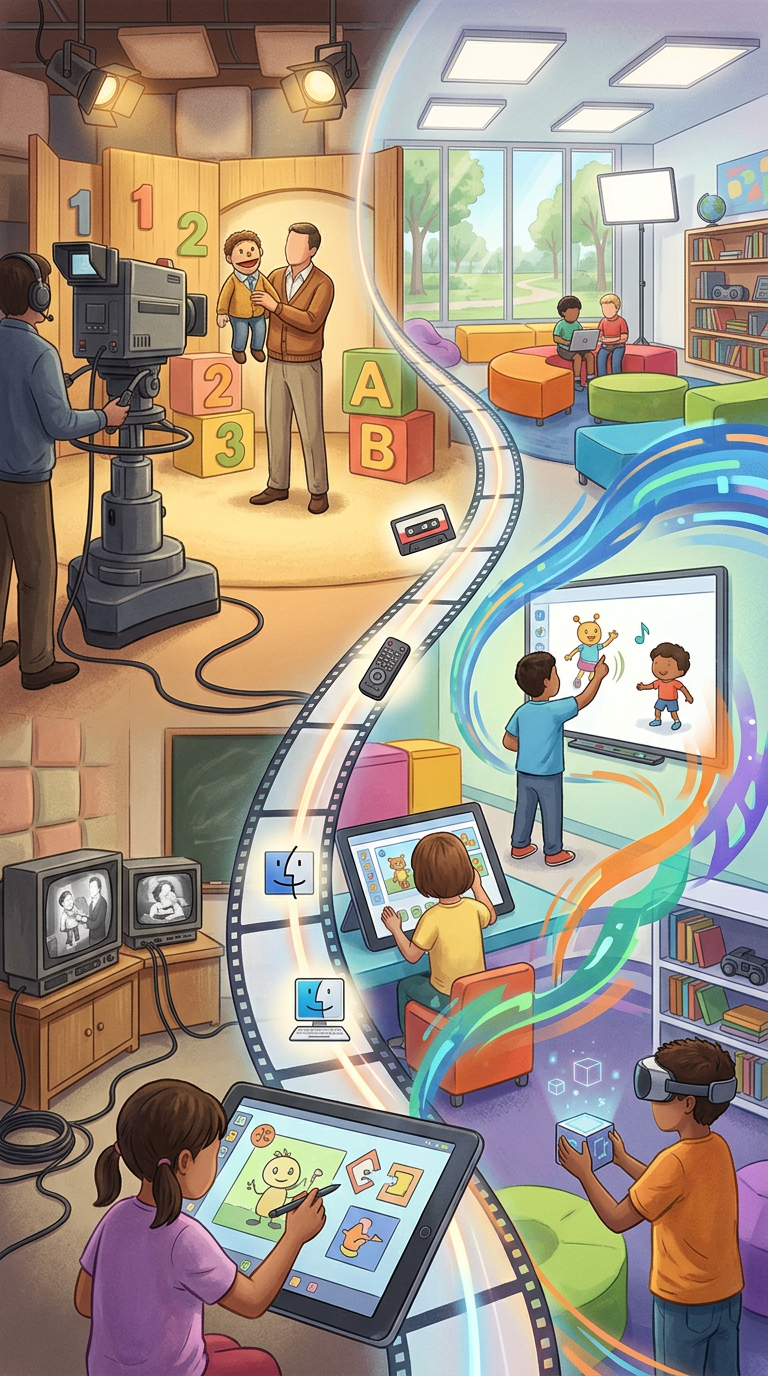
In today’s culture, celebrities are often idealized, raising an essential question: whom should we admire, and why? Few figures in television have exerted a more enduring social impact than Fred Rogers, the creators of Sesame Street, and Rachel Accurso (Ms. Rachel). In an age dominated by algorithmic feeds and hyper-stimulating screen exposure, Mister Rogers’ Neighborhood, Sesame Street, and Songs for Littles prioritize research-grounded development over passive consumption. Through direct eye contact, purposeful music, puppet proxies, deliberate pacing, and age-appropriate pedagogy, these programs cultivate language acquisition, empathy, self-regulation, and emotional literacy—proving that children’s media can nurture foundational human capabilities rather than merely holding attention.
“True childhood education cannot stop at the living room screen; it requires standing up for the basic human dignity of every child, everywhere.”
Quiet Radicalism:
Fred Rogers and Moral Courage
The blueprint for this pedagogical courage began with Fred Rogers, who confronted mid-century social upheaval not with dogma, but with radical, quiet human dignity. During the height of the Civil Rights movement in 1969, as public pools were desegregated amid racially charged violence, Rogers invited François Clemmons—who portrayed Officer Clemmons—to share a small wading pool to cool their feet. Rogers concluded the scene by helping Clemmons dry his feet, presenting an indelible visual of mutual respect and shared humanity. He met national tragedy with the same unyielding honesty; just days after the assassination of Robert F. Kennedy, an episode aired where Daniel Tiger asked what “assassination” actually meant, granting young viewers permission to voice the dread permeating their homes. Whether welcoming ten-year-old Jeff Erlanger to candidly explain his electric wheelchair while singing “It’s You I Like,” or destigmatizing divorce by reassuring children that parental separation is never their fault, Rogers proved that emotional transparency could disarm societal fear.
Systemic Normalization:
The Legacy of Sesame Street
Concurrently, Sesame Street brought that mission to a systemic scale by transforming the television screen into an integrated urban neighborhood. Conceived by the Children’s Television Workshop as an educational intervention for under-resourced inner-city youth, its 1969 debut featured an integrated Black, White, and Latino cast whose harmonious coexistence proved so boundary-pushing that Mississippi’s state educational network initially banned the broadcast. Over the ensuing decades, the series continually deployed its Muppets as accessible proxies for complex cultural challenges: it established the gold standard for navigating childhood grief when actor Will Lee (Mr. Hooper) died in 1983; introduced Kami, an HIV-positive orphaned Muppet in South Africa, to destigmatize a global health crisis in 2002; and later welcomed Julia to normalize autism. By expanding into storylines about parental incarceration, substance use recovery, and foster care, the show consistently reframed societal hardships not as personal failures, but as collective challenges demanding community empathy.
Democratizing Development:
Ms. Rachel in the Digital Era
In the digital era, Rachel Accurso has carried this ethos into the social media age, using open-access platforms to democratize early intervention during an era marked by pandemic-related speech delays and isolation. Through Songs for Littles, Accurso translates clinical speech-language pathology methods—such as exaggerated phonetic pauses, gestural scaffolding, and close-up mouth framing—directly into accessible video formats, offering vital support to families navigating prohibitive therapy costs and long waitlists. Just as crucially, she integrates contemporary diversity into the fabric of early childhood learning, featuring neurodivergent children, racially diverse casts, and LGBTQ+ co-hosts without framing their presence as an exception or a debate. Accurso also extends this educational umbrella to caregivers, directly addressing postpartum depression, isolation, and parental guilt to remind adults that “good enough” parenting is valid, proving that early media can build intrinsic empathy while supporting the family unit as a whole.
Advocacy Beyond the Screen
Ultimately, what unites Fred Rogers, Sesame Street, and Rachel Accurso is a moral refusal to draw boundaries around which children are worthy of protection and a voice. In an era marked by deep political polarization and institutional cruelty—crystallized by the ongoing humanitarian realities within ICE family detention facilities across the United States—Accurso has emerged as an essential modern advocate because she refuses to treat child welfare as a spectator sport. Much like Rogers stepping into the wading pool with François Clemmons or Sesame Street defending marginalized communities in 1969, Ms. Rachel has leveraged her massive platform far beyond toddler songs. By petitioning to close family detention centers, hand-delivering detained children’s artwork to Capitol Hill, and demanding public accountability for the trauma inflicted on immigrant families, she reminds us that genuine early childhood education cannot stop at the edge of the screen. In a society that too often looks away from systemic neglect, her work demonstrates that early advocacy is not just about teaching children how to speak—it is about using our own voices to ensure none of them are left suffering in the dark.
“Early childhood advocacy is not just about teaching children how to speak—it is about using our own voices to ensure none of them are left suffering in the dark.”

