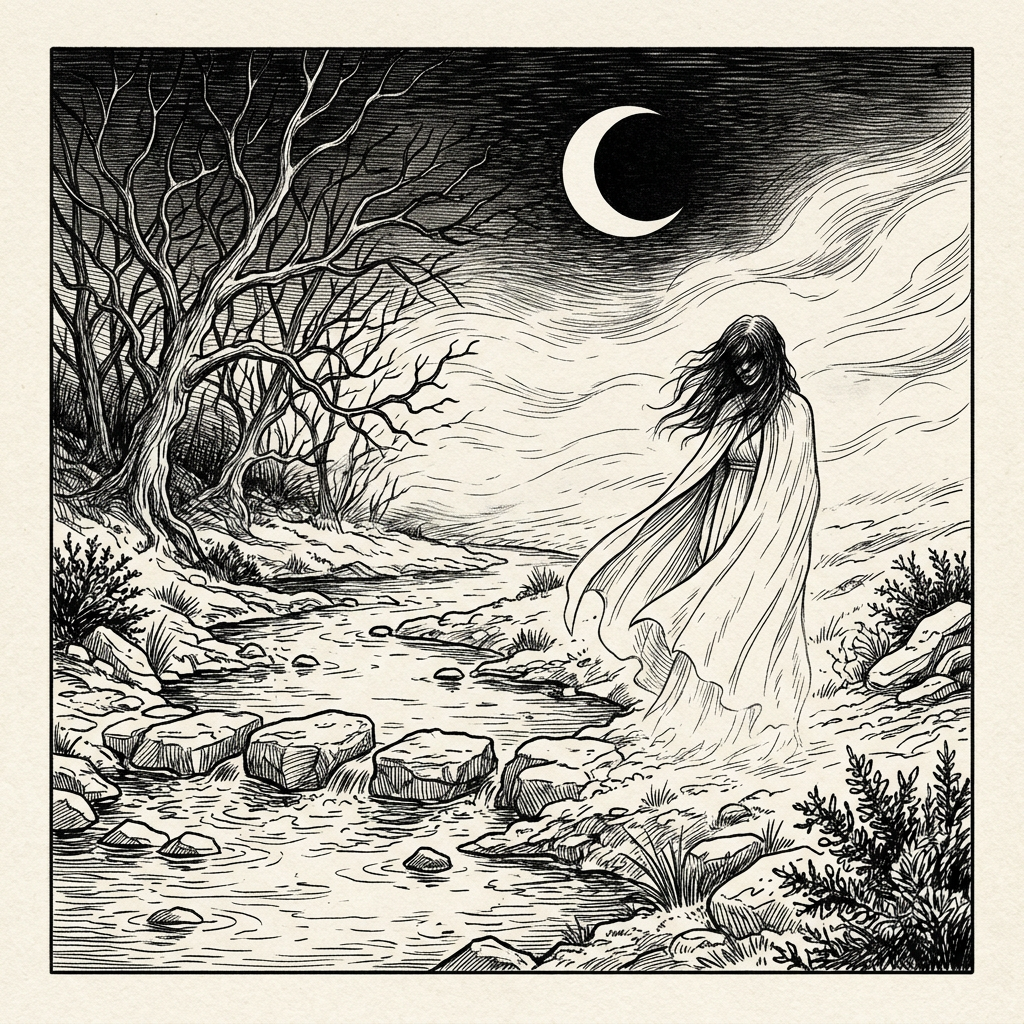
Step outside on a late October night after the deciduous trees have dropped their leaves, and you will notice that the wind sounds fundamentally different than it did in August. Instead of a soft, rustling canopy, the gale whistles across bare, rigid branches and stone chimneys in long, rising cadences. To our Gaelic ancestors, that chilling acoustic shift heralded the arrival of the Bean Sí—the Banshee.
The Ancestral Herald, Not the Predator
Modern pop culture often reduces the Banshee to a vengeful monster whose scream kills the listener, but traditional Irish and Highland Scottish lore tells a far more melancholic story. The Bean Sí (“woman of the fairy mounds”) never caused death. Rather, she was an otherworldly ancestral guardian attached to specific historic families, arriving in the dark hours to sing the caoineadh (the keen)—a haunting, wordless lament to warn the household that a loved one was about to cross the veil.
The Three Omens of the Bean Sí
The Washer at the Ford (Bean Nighe)
In Scottish and northern Irish tradition, travelers crossing a lonely stream at twilight might spot a small, hooded woman kneeling in the freezing water, scrubbing bloodstained linen shirts against the flat stones. If you were brave enough to approach and ask whose garments she washed, she was bound to speak the name of the person destined to die before the season ended.
The Trap of the Silver Comb
The Banshee was frequently described sitting atop a stone wall or beneath a hawthorn tree, weeping while tearing a silver or bone comb through her long, streaming hair. Irish folk warnings strictly forbade anyone from picking up a lost comb found on a country road in October; taking it home meant the Banshee would follow her property straight to your window and keen under your eaves until you slid the comb back out using a pair of iron fireplace tongs.
The Chorus of the Keen
While a single Banshee wailed for an ordinary mortal, folklore held that when a great poet, chieftain, or holy person lay dying, multiple Banshees gathered in the gale outside, weaving their voices into an eerie, polyphonic choir.
“Hear the wind in the bare ash tree—it is not the storm that weeps, it is the woman of the mound combing her hair.”
Gaelic Fireside Lore

Acoustic Pareidolia:
Why We Hear Voices in the Gale
Why have humans across every continent sworn they heard a woman weeping or calling their name in the autumn wind? Sensory neuroscience points to auditory pareidolia combined with fluid dynamics.
When wind rushes past cylindrical obstacles like bare October twigs, roof eaves, or window gaps, it creates alternating swirling vortices known as vortex shedding (or “aeolian tones”). These fluctuating air pressures naturally oscillate between 500 Hz and 3,000 Hz—the exact acoustic frequency band of a human voice or infant cry. Because the human auditory cortex evolved under intense evolutionary pressure to never miss a distress call in the dark, our brains automatically “fill in” chaotic wind frequencies with the unmistakable sound of human wailing.
Voices in the Gale
“Have you ever woken up at 3 AM convinced you heard someone crying or calling your name outside, only to realize it was the wind against the house?”