Building a life across multiple languages and cultures is one of the most remarkable forms of human adaptation. Yet because this work happens almost entirely inside the mind, it often goes unnoticed. Fluency is admired, accents are discussed, and multilingualism is celebrated as a practical skill, but the invisible architecture that makes it possible is rarely acknowledged.
To speak more than one language is not simply to possess multiple vocabularies. It is to carry multiple systems of thought, different emotional landscapes, competing cultural expectations, and several versions of oneself that emerge depending on the environment.
Every conversation becomes an act of navigation.
Every interaction requires subtle recalibration.
Every transition asks the brain to decide which version of reality is most appropriate for this particular moment.
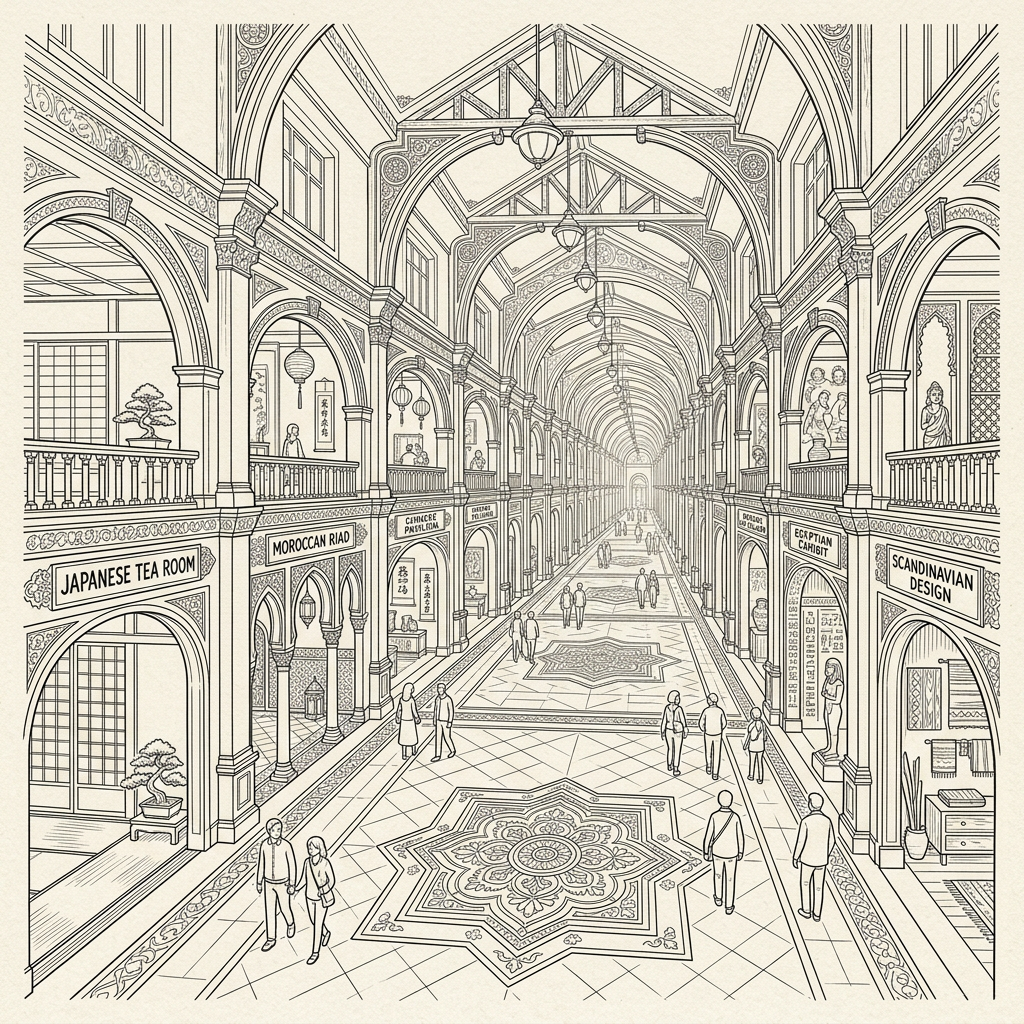
This invisible space—the place between languages rather than inside any one of them—is what I call The Polyglot’s Hallway.
A hallway is not a destination. It is a place of movement. We pass through it to reach another room, yet we often spend far more time there than we realize. For multilingual and multicultural people, life itself can begin to resemble this hallway: a continuous movement between identities, histories, and emotional worlds.
Far from being a sign of uncertainty, this hallway is where identity is constantly being rebuilt.
More Than Translation
Many people assume that speaking another language is simply a matter of replacing one word with another. Anyone who has lived in more than one language knows this is an illusion.
Languages do not merely label reality.
They organize it.
They teach us what deserves attention, how emotions should be expressed, how respect is demonstrated, when silence is appropriate, and even what kinds of humour are acceptable.
A greeting is never just a greeting.
An apology is never just an apology.
Even something as simple as saying “thank you” or “I love you” carries different emotional weight depending on the language being spoken.
When we change languages, we are often changing the social rules that accompany them.
Our voice changes.
Our rhythm changes.
Our confidence changes.
Sometimes our personality appears to change as well—not because we become different people, but because each language unlocks different parts of ourselves.
The Polyglot’s Paradox
Immersion is often celebrated as the fastest path toward fluency. The advice is familiar: think in your target language, surround yourself with native speakers, and avoid relying on your first language.
There is wisdom in this approach.
Yet it creates a paradox.
To fully inhabit a new language, we often need to quiet another language that has shaped our thinking for decades.
For a brief period, our internal world becomes suspended between two systems.
Then, just as the new language begins to feel natural, life demands another transition.
A phone call from family.
A conversation at work.
An old friend.
A childhood memory.
Suddenly another language rushes back into consciousness.
Rather than living inside separate linguistic compartments, multilingual people often carry every language at once. One waits quietly while another takes the stage, but none truly disappear.
This continual negotiation produces what many polyglots describe as a subtle mental static—a background awareness that multiple cultural operating systems remain active simultaneously.
The Hidden Cost of Context Switching
Switching languages is often described as effortless once fluency develops.
From the outside, it certainly appears that way.
Inside the brain, however, something much more sophisticated is happening.
Every switch requires the mind to deactivate one set of grammatical rules while activating another. Vocabulary must be reorganized. Pronunciation shifts. Social expectations change. Emotional cues are recalculated.
But language is only one layer.
Context changes as well.
Professional English may suddenly become intimate Italian.
Formal French may give way to neighbourhood slang.
Academic vocabulary may transform into family expressions that have existed for generations.
The brain is not simply translating.
It is rebuilding the entire context surrounding every interaction.
After hours of doing this repeatedly, many multilingual people experience a unique exhaustion that has little to do with speaking itself.
The fatigue comes from rebuilding reality over and over again.
Linguistic Fatigue
This hidden exhaustion deserves its own name.
Linguistic fatigue is the mental wear that develops through continuous language and context switching.
It often appears in unexpected ways.
Words disappear just when they are needed.
Simple decisions suddenly require unusual effort.
Thoughts become slower.
Conversations feel heavier.
Many multilingual people describe knowing exactly what they want to communicate while simultaneously feeling unable to access the precise language required to express it.
To outside observers, this may appear as forgetfulness.
Internally, it feels more like having every book in a library available while someone keeps changing the catalogue system.
Emotional Compression
Perhaps an even deeper challenge is what could be called emotional compression.
Every language possesses words that cannot be perfectly translated.
Some emotions exist vividly in one language yet feel diluted in another.
The result is not simply missing vocabulary.
It is losing emotional precision.
Imagine trying to explain grief, longing, belonging, or love while every available word feels slightly inaccurate.
The emotion remains intact.
The expression becomes compressed.
This creates a strange experience where an adult possesses decades of emotional complexity but temporarily sounds less articulate simply because the available language cannot fully contain what they wish to express.
This disconnect often leaves multilingual people feeling misunderstood despite communicating accurately.
Living Between Standard and Hybrid Languages
Few multilingual people speak entirely “pure” versions of any language.
Most grow up surrounded by mixtures.
Italian blended with English.
French coloured by neighbourhood expressions.
Arabic infused with local slang.
Spanish influenced by regional dialects.
Over time these combinations become authentic languages of their own.
Yet hybrid speech often occupies an uncomfortable social position.
Too informal for classrooms.
Too localized for official institutions.
Too different for some native speakers.
Too foreign for others.
Many multilingual people therefore experience a subtle pressure to edit themselves depending on who is listening.
Rather than speaking naturally, they begin performing whichever version of language feels safest.
Authenticity becomes conditional.
Memory Lives Inside Language
One of the most surprising discoveries in psychology is that memory is often language-dependent.
A familiar phrase can unlock childhood experiences that seemed forgotten.
A grandmother’s expression can resurrect emotions untouched for decades.
The smell of a family meal combined with hearing one’s first language can collapse years in an instant.
Sometimes we believe we miss a country.
In reality, we miss the language through which we experienced that chapter of life.
Language becomes an emotional time machine.
Each language stores different memories, different relationships, and different versions of ourselves.
Changing languages therefore becomes something much larger than communication.
It becomes an act of travelling through one’s own history.
The Comfort—and Danger—of Nostalgia
This is where nostalgia enters the hallway.
When life feels uncertain, memory offers stability.
Our past appears organized because we already know how the story ended.
The future offers no such certainty.
Doug Larson once observed:
“Nostalgia is a file that removes the rough edges from the good old days.”
The quote captures an important psychological truth.
Memory edits.
It softens conflict.
It brightens familiar places.
It transforms ordinary routines into symbols of belonging.
For multilingual people, nostalgia often attaches itself not only to places but also to sounds.
A dialect.
An accent.
A family joke.
A childhood song.
Sometimes hearing a language spoken by strangers can evoke emotions stronger than returning to the physical place itself.
When Nostalgia Becomes a Fortress
Nostalgia is healthy when it reminds us where we came from.
It becomes harmful when it convinces us we can only belong there.
There is also the phenomenon known as anemoia—nostalgia for a time we never personally lived.
Family stories, inherited traditions, and cultural myths can become so emotionally powerful that we begin longing for versions of the past that never actually existed.
This imagined history can quietly influence present decisions.
We compare today’s relationships with idealized memories.
We compare modern communities with stories passed down through generations.
Without realizing it, we ask the present to compete with a past that has already been edited by memory.
No present moment can win that competition.
Love Speaks in Dialects Too
Eventually the hallway expands beyond language.
It enters our relationships.
Two people from different cultural backgrounds rarely disagree only because of personality.
More often, they are interpreting the same situation through entirely different emotional grammars.
One partner may express love through constant conversation.
Another through practical help.
One seeks reassurance.
The other demonstrates loyalty through quiet consistency.
Neither is withholding love.
They are speaking different relational dialects.
The tragedy is that both may feel unseen despite loving each other deeply.
The work of intercultural relationships is therefore not simply learning another person’s habits.
It is learning the emotional grammar beneath those habits.
Beyond “That’s Just How I Was Raised”
Culture explains many of our behaviours.
It does not excuse our refusal to examine them.
Phrases such as:
“That’s just how my family communicates.”
“That’s simply how our culture works.”
“That’s just who I am.”
can be truthful.
They can also become protective walls.
Growth begins when heritage becomes a foundation rather than a prison.
Honouring our upbringing does not require reproducing every inherited pattern.
Some traditions deserve preservation.
Others deserve thoughtful revision.
Identity is not a museum exhibit frozen in time.
It is architecture under continual renovation.
The Hallway Is Not a Place to Escape
Many people spend years trying to decide where they truly belong.
One country.
One language.
One culture.
One identity.
Perhaps that question misunderstands the experience entirely.
Perhaps belonging was never meant to exist in a single room.
Perhaps it exists in the hallway itself.
The hallway is where we carry our grandparents into conversations with our children.
It is where childhood dialects meet professional vocabulary.
It is where old traditions negotiate with new possibilities.
Rather than choosing between identities, multilingual people often become builders of entirely new ones.
Their lives are not divided.
They are layered.
And every language, every migration, every friendship, every misunderstanding, and every act of adaptation adds another room to the house they are constructing.
Home is no longer only a place left behind.
It becomes something carried forward.
It becomes the architecture of a life intentionally built between worlds.
🚪 Step Into the Hallway
We all carry invisible hallways within us—spaces where languages overlap, cultures intertwine, memories echo, and identities quietly evolve.
Have you ever felt like a slightly different person depending on the language you speak?
Has a single word, accent, or familiar expression ever unlocked a memory you thought you’d forgotten?
When you revisit your past, are you using it as a foundation to build something new—or as a blueprint that keeps you from moving forward?
There are no right or wrong answers—only stories that help us better understand one another.
Share your experience in the comments below. Your perspective may resonate with someone else walking their own hallway between languages, cultures, and generations.
