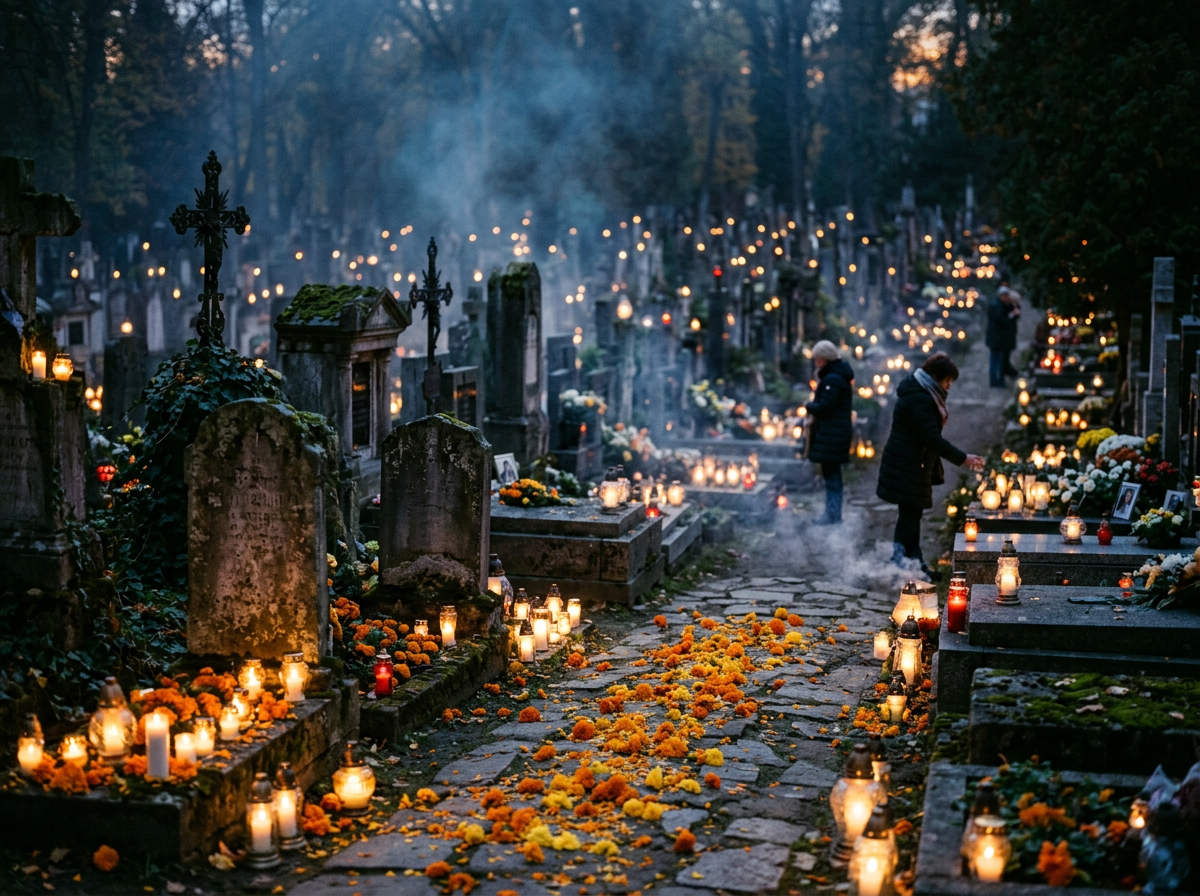
If October 31st belongs to the uncanny unknown and November 1st belongs to the sanctified and innocent, November 2nd belongs directly to the dead. Known across the Christian calendar as All Souls’ Day and across Latin America as the grand culmination of Día de los Muertos, this date represents the deepest, most personal communion of late autumn.
The Day of the Faithful Departed
Formally instituted in the late 10th century by Saint Odilo, Abbot of Cluny, All Souls’ Day shifted the lens away from heavenly saints to the ordinary ancestors whose memory still lingered in family homes. It was a day designed for ordinary grief—a designated hour in the calendar when the living bridged the distance to those sleeping beneath the churchyard grass.
Rather than a day of dark despair, folklore and regional customs transformed November 2nd into a sensory festival of light, scent, and communion.
Candles, Marigolds, and the Returning Feast

The Scent of Cempasúchil (Mexican Marigolds)
On November 2nd, the spirits of adults are welcomed across the threshold in full celebration. Families create long, radiant trails of orange cempasúchil petals from city streets and cemetery gates directly into living rooms. The vibrant neon-amber hue and pungent herbal scent are believed to act as an aromatic pathway cutting through the spiritual ether to guide wandering ancestors home to their ofrenda.
The Cemetery of Lanterns (Zaduszki)
Across Poland, Lithuania, and Slavic Eastern Europe, November 2nd is Zaduszki. As dusk descends, entire communities gather inside parish cemeteries, scrubbing away dead moss, cleaning family headstones, and lighting heavy glass-cased wax candles (znicze). By nightfall, churchyards become glowing seas of amber light visible from miles away, designed to keep souls warm through the dark season.
The Bread of the Dead
In parts of southern Europe and Mexico, ritual breads—such as pan de muerto shaped with dough crossbones or Italian fave dei morti (almond bean cookies)—are baked and consumed. Eating these sweets is a ritual act of swallowing grief and celebrating the unbroken lineage connecting the past with the present.
“They are not truly gone who live in hearts they leave behind; light the taper, pour the cup, and scatter the petals to show them the way.”
Folk Commemoration Lore

An Anchor Against the Dark Season
To walk through an illuminated cemetery on the night of November 2nd is to witness grief stripped of its silence. By greeting mortality with food, music, flickering beeswax, and vivid marigolds, our ancestors ensured that death did not mean erasure. As the cold winter nights close in, we light candles not because we fear what lurks in the dark, but because love refuses to be forgotten.
The Sea of Lanterns
“If you walked through an old cemetery tonight lit by hundreds of glowing beeswax lanterns, would it feel somber, comforting, or beautiful to you?”