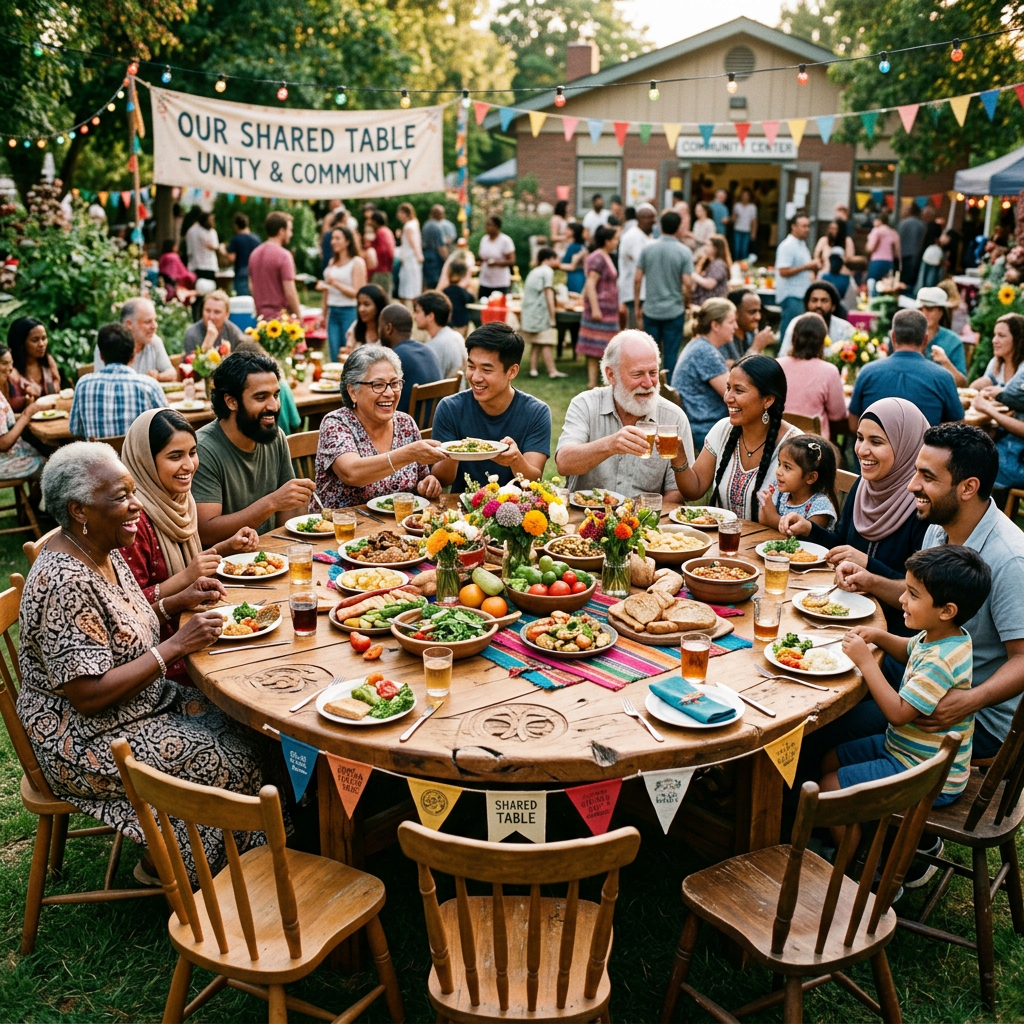
June in Canada arrives with a unique, transformative energy. As the evenings stretch longer, the country shifts into a collective space of celebration and reflection. It is a rare moment on our cultural calendar where National Indigenous History Month, Italian Heritage Month, and Pride Month all share the stage.
Instead of treating these as three separate dates to check off a calendar, we invite you to pull up a chair to a conceptual “Community Table.”
Across Indigenous, Italian-Canadian, and 2SLGBTQ+ communities, the simple acts of sharing food, preserving history, and holding space are far more than mere traditions—they are the ultimate expressions of love and political resistance. At this table, stories are not just told; they are passed down as a means of survival.
Sharing Food:
A Language of Survival and Nurturing
Food is never merely sustenance; it is a profound cultural language of hospitality, survival, and active resistance against erasure. At our shared, conceptual “Community Table,” food becomes a revolutionary tool to claim physical space, pass down fractured heritages, and protect those we love. While the ingredients differ across Italian-Canadian, Indigenous, and 2SLGBTQ+ communities, the core intention remains identical: feeding our people is how we ensure they survive.
The Italian-Canadian Matriarch: Keeping the Homeland Alive
In traditional Italian culture, la famiglia revolves entirely around the kitchen table. This space has historically been anchored and fiercely protected by the matriarch. For early Italian immigrants navigating a new and often hostile environment, the preservation of culinary traditions was far more than a domestic chore—it was a silent, defiant act of cultural resilience.
This resilience faced its darkest test between 1940 and 1943. Following Italy’s entry into World War II, the Canadian government invoked the War Measures Act, labeling thousands of working-class Italian-Canadians as “enemy aliens” and seizing family homes, bank accounts, and businesses. With primary breadwinners abruptly sent to isolated internment camps , the matriarchs left behind kept their families tethered to their roots through the simple, radical act of baking bread, rolling pasta, and keeping the stove warm. Food became the literal and emotional glue that kept a fragmented heritage alive.
Indigenous Land Stewardship: Reclaiming the Sacred Cycle
For Indigenous nations across Turtle Island, food is inextricably tied to land connection, community care, and seasonal cycles. Decades of colonial displacement and the forced separation of nations from their ancestral territories heavily disrupted traditional agricultural, hunting, and foraging networks. Because of this history, revitalizing traditional foodways today serves as a powerful, direct act of decolonization.
An excellent example of this modern reclamation is the annual “Taste of Solstice“ featured at the Summer Solstice Indigenous Festival. This curated culinary experience features Indigenous chefs showcasing hand-crafted plates that link communities directly back to the land and water. To share a plate of hand-harvested ingredients during the longest days of June is to declare that the connection between Indigenous peoples and their ancestral lands remains unbroken.
The 2SLGBTQ+ Chosen Family: Sanctuary at the Table
For the queer and Two-Spirit communities, breaking bread together forms the literal cornerstone of the “chosen family.” When rigid, traditional, or biological family structures reject queer individuals for stepping outside of heteronormative scripts, the threat of isolation is immense. In response, the 2SLGBTQ+ community has long used communal meals to build an alternate architecture of safety.
Gathering around a table in a safe, affirming space becomes a vital, life-saving act of mutual care. It is a sanctuary where complex, intersectional identities do not have to hide. Whether it is a quiet Sunday lunch inside a queer immigrant household or a massive community potluck after a Pride march, passing a plate ensures that history is shared, safety is established, and a new community is built.
| Community Space | Cultural Role of the Meal | The Ultimate Act of Resistance |
| Italian-Canadian | Reconciling the immigrant dream around la famiglia. | Defying historical stigma and wartime asset seizure through culinary preservation. |
| Indigenous | Centering ancestral foodways and seasonal governance. | Pushing back against colonial displacement through land connection and food revitalization. |
| 2SLGBTQ+ | Establishing unconditional safety for marginalized identities. | Replacing systemic exclusion with radical, life-saving mutual care. |
Reclaiming the Past:
The Radical Act of Preserving Our History
For all three of these communities, dominant historical narratives have frequently relied on forced silence, systematic erasure, or institutional denial. Reclaiming these hidden histories and documenting them in the light of day is not just about looking backward—it is a radical act of political and cultural resistance.
Two-Spirit Reclamation: Restoring Sacred Roles
Grounding history in the pre-colonial roles of Two-Spirit individuals is a profound way to honor Indigenous heritage during Pride. Long before colonization brought rigid, binary frameworks to Turtle Island, many Indigenous nations explicitly celebrated Two-Spirit people. They were revered as sacred healers, visionaries, counselors, and keepers of oral history. By returning to these deep-rooted ancestral truths, the 2SLGBTQ+ narrative moves past modern, corporate marketing and returns to a sacred, historically embedded identity.
Shattering L’omertà: Queer Immigrant Narratives
Within traditional diaspora circles, navigating an identity outside of the standard heteronormative script has historically been met with intense taboo or l’omertà—a protective, yet deeply painful cultural silence. In many immigrant households, the “immigrant dream” was tied to a rigid cycle: working grueling hours, securing a home, marrying, and passing that exact cycle down to the next generation. Stepping outside of that expectation could feel like a disruption to the family’s immense sacrifices.
To break this cycle, groundbreaking literary projects like Licia Canton’s Here & Now anthologies (Volume 1 released in 2021; Volume 2 in 2024) explicitly declare that queer individuals have always existed within immigrant heritages. Developed alongside academic institutions like the Frank Iacobucci Centre for Italian-Canadian Studies at the University of Toronto, this comprehensive collection brings together writers from their twenties to their eighties. Publishing these works is a radical break from generational conformity. It ensures that the distinct architecture of these lived experiences—spanning fiction, poetry, and memoirs—is permanently recorded in Canadian social history.
“The goal is to create a reality where there is less silence during Sunday lunch—allowing individuals to bring their whole selves to the family table.” — Scholar Mirko Casagranda, Here & Now Volume 2 Launch
Unlocking the Past: Facing Difficult Truths
Preserving history also means confronting the heavy, structural injustices that state narratives have tried to minimize. Just as the queer diaspora fights erasure, Italian-Canadians have had to break the painful stigma surrounding the WWII internment.
Following Italy’s declaration of war in 1940, the Canadian government invoked the War Measures Act, labeling roughly 31,000 Italian-Canadians as “enemy aliens”. Hundreds of men were arbitrarily arrested without charges, taken from their families, and sent to isolated military camps. Back home, the government seized their houses, bank accounts, and businesses, leaving families to face financial ruin and social ostracization. For decades, this trauma was buried under a defensive silence. Reclaiming it through creative and critical literature ensures that the sacrifices of the past are accurately remembered, moving the community toward true healing and political redress.
Holding Space:
Creating Sanctuaries for Identity
Whether it is a physical plot of land, a broadcast signal, or an artistic medium, holding space allows complex, intersectional identities to safely exist without compromise. Throughout Canadian history, trailblazers have fought against institutional inertia to build these vital sanctuaries.
The Legal Sphere: Frank Iacobucci’s Jurisprudence of Empathy
The Honourable Frank Iacobucci, the first Italian-Canadian appointed to the Supreme Court of Canada, dedicated his life to rewriting how institutions engage with marginalized communities. Born to working-class immigrants, he understood what it felt like to navigate spaces not originally built for you. While his judicial career was historic, his post-bench legacy truly transformed Canada’s path toward Indigenous justice. Iacobucci recognized that strict, adversarial courtrooms were fundamentally ill-equipped to handle systemic cultural trauma.
- The Residential Schools Settlement (2005–2006): He led the highly sensitive discussions that resulted in the largest class-action settlement in Canadian history, directly laying the groundwork for the Truth and Reconciliation Commission (TRC).
- A Relationship-First Model: As a lead negotiator with the Chiefs of the Matawa Tribal Council regarding the Ring of Fire regional infrastructure, he explicitly tossed out aggressive corporate legal tactics. Instead, he championed a relationship-and-partnership model rooted in mutual respect.
Iacobucci proved that holding space within the law means moving away from systemic binaries and treating Indigenous communities as genuine, foundational partners.
***The Airwaves: Johnny Lombardi’s Multicultural Revolution
Concurrently, in the cultural sphere, media pioneer Johnny Lombardi was fighting a parallel battle on the Canadian airwaves. The son of Italian immigrants and a WWII veteran, Lombardi founded CHIN Radio in 1966 during an era when the concept of multiculturalism was actively discouraged by authorities.
For decades, the Canadian government had implemented aggressive regulatory caps and strict licensing policies that heavily restricted “third languages” (languages other than English, French, or Indigenous tongues). Institutional policy dictated that broadcasting should enforce a rigid, singular Canadian identity.
Lombardi broke through this hostile climate. By aggressively advocating for the cultural and commercial value of multilingual programming, CHIN initially broadcasted in over 32 languages, effectively giving a literal voice to millions of displaced immigrants. Lombardi forced a permanent paradigm shift in Canadian broadcasting, proving that the airwaves belonged to everyone.
Modern Sanctuaries: Carrying the Torch
Today, that exact legacy of holding physical and creative space continues across Canada:
- Sacred Landscapes: Spaces like Ottawa’s Mādahòkì Farm (home to the endangered, ancestral Ojibwe Spirit Horses) or Pīndigen Park hold physical land for Indigenous reflection, agricultural insight, and traditional land stewardship.
- Creative Pockets of Resistance: Cultural advocates, writers, and queer organizers continue to use film, literature, and community gathering to build safe spaces within historically conservative institutions. They ensure that the next generation of intersectional storytellers can bring their whole selves to the table without fear of erasure.
Editor’s Note: The Expansive Table
Ultimately, the “Community Table” is infinitely elastic. True resistance is not always a loud protest in the street—sometimes it is the quiet, revolutionary act of passing down a recipe, archiving a hidden piece of history, or pulling up an extra chair for someone who has been told they do not belong. All three communities use these exact tools to survive, evolve, and lead with love.
💬 Join the Conversation
What are your thoughts? Have you explored the intersections of heritage and identity in your own circles? Let us know how you are holding space this June in the comments below!
